
Key Takeaways
- Execution rarely fails because people don't work hard. It fails because too many things are in progress at once.
- 3+ is an operating loop: Focus → Quality → Delivery → repeat. The goal is speed through finishing, not speed through starting.
- The "3" is a practical capacity limit: more parallel work increases waiting, switching, and rework, which slows real throughput.
- Focus means limiting WIP, sequencing the backlog, and committing to finishing what you start.
- Quality is not perfection; it's building the right 80% and keeping systems simple enough to scale without rework.
- Delivery is loop-closing discipline: done, shipped, learned — not "almost done" work that drifts.
- The "+" is the scaling mechanism: one shared priority list, explicit decision rights, and no shadow strategies across functions.
The execution paradox
I've never seen execution fail because people weren't working hard.
It fails because too many things are "in progress" at the same time.
In scaling organizations, a familiar pattern repeats. When teams try to push ten priorities forward in parallel, everything becomes slower, quality drops, and we end up doing work twice. Work piles up as "almost there" initiatives: half-decisions, half-built features, half-implemented processes. Everyone is busy, but delivery slows.
How 3+ was born
During my time at EstateGuru, I needed a simple rule that would keep execution sharp under pressure. I had learned pieces of the puzzle from different worlds: Lean, Agile, banking operations, 4DX, psychology, and military planning. But I needed something teams could actually live by every day.
That's how 3+ was born.
Not as a slogan, but as an operating concept: we do fewer things at once, we deliver them with quality, and we deliver them fast. Then we reprioritize.
3+ is a loop: Focus → Quality → Delivery → repeat.
And the "+" is what makes it work at scale: alignment, shared ownership, and real collaboration.
Why "3" is not random
This is not about a magic number. It's about limits.
In complex organizations, your effective capacity is always lower than people think because everything has dependencies. Every additional initiative adds coordination, waiting, switching, and rework risk.
You can describe the same truth from different angles:
- Cognitive bandwidth: context switching is expensive, especially when work is ambiguous and cross-functional.
- Flow and WIP: when work-in-progress grows, cycle time grows. More parallel work creates more waiting, not more throughput.
- Feedback loops: smaller finished increments create learning and momentum. "Almost done" creates neither.
- OODA loop (military planning): speed comes from cycling faster than the environment changes. That requires finishing actions, not accumulating unfinished ones.
- 4DX: execution improves when you focus on a small set of wildly important outcomes and build cadence around them.
Different fields, same conclusion: you don't go faster by adding more. You go faster by finishing.
The three pillars: Focus
Focus means:
- Concentrating on three main efforts at a time
- With a view to long-term success
- Reprioritizing after each delivery
The "long-term success" part matters. It doesn't mean we ignore the future. It means we manage it intentionally.
You can keep big strategic moves in the backlog, but you sequence them. Example: you may want to expand to a new country, but first you need reserves, proven unit economics, or stabilized risk and operations. Expansion is not forbidden. It's simply "not now." It stays in the backlog until prerequisites are delivered.
Focus also means limiting work-in-progress and using tight timeboxes, because learning happens only when something is finished.
When I was CEO, a recurring question I asked was simple: What is the most important thing right now?
In military planning, the same question is often framed as: What is the main effort, and what outcome do we expect from it?
The point is direct. If you don't deliver the main effort, everything else loses relevance, because it was built on top of an unfinished base.
So Focus usually boils down to two rules:
- Limit work-in-progress (WIP): fewer initiatives in flight.
- Use tighter deadlines/timeboxes: learning happens when something is finished, not when it's 80% done.
If we add something, we remove something. If we start something, we commit to finishing it.
The three pillars: Quality
Quality means:
- Delivering outcomes that add value (use the 80/20 lens)
- Getting things right the first time (so we don't pay the rework tax later)
- Achieving aesthetic simplicity (so the system scales)
Quality isn't perfection. It's clarity on what matters most. It's the discipline of building the right 80% so we don't spend months paying for rework later.
There's an important nuance here. A healthy operating feel is often that we move fast enough that there's a slight sense that, with more time, we could make it "even better." That pressure forces prioritization and prevents perfectionism from becoming a delay mechanism.
A simple mental model:
- If everything feels comfortable, you are probably under-shipping.
- If everything feels chaotic, you probably have too much WIP or a weak cadence.
Quality is what prevents speed from turning into rework.
And "aesthetic simplicity" matters more than people think. When things are simple, teams move faster: fewer rules, fewer exceptions, fewer misunderstandings. Simplicity scales.
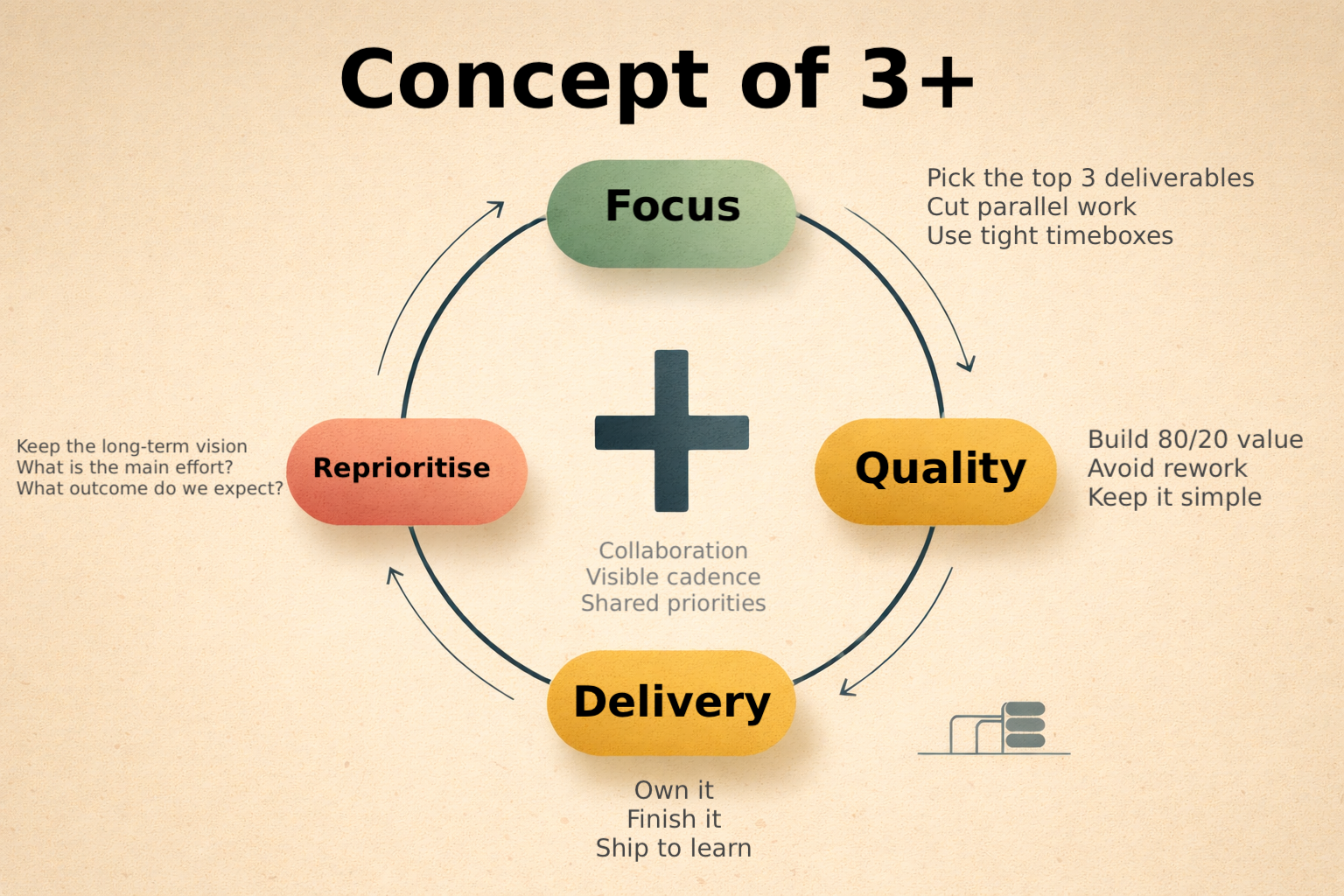
The three pillars: Delivery
Delivery means:
- Taking ownership and showing initiative
- Executing tasks to completion
- Prioritizing speed of delivery because it shortens the learning cycle
This is where many teams break. They "progress," but they don't finish.
Delivery means we build a culture of closing loops. Not "almost done," not "in review," not "waiting for someone."
Done. Shipped. Closed. Learned.
Speed matters because it shortens the feedback loop. Fast delivery creates fast feedback, which creates better decisions. That is the same logic as OODA: the faster you complete cycles, the more adaptive you become.
Delivery discipline also includes a cultural standard: initiative matters. If you see a blocker, you don't only report it. You propose a path through it.
The "+": alignment, shared ownership, one priority list
The "+" is not a nice-to-have. It's the scaling mechanism.
It means we are aligned to the same cause, supporting each other, and each doing our part. Most importantly: everyone in the company should know what the current top priorities are.
There cannot be a situation where company strategy is to deliver a new investor product, while Legal is quietly preparing expansion to a new country, if expansion is not a priority right now.
If something is not one of the top priorities, we don't "quietly continue it." We stop it, park it, or explicitly rescope it.
In practice, "+" looks like:
- One shared priority list across functions
- Clear decision rights and a visible cadence
- No parallel "shadow strategies" inside departments
- Ownership without ego ("I own it" does not mean "I do it alone")
- Surfacing problems early (no quiet failure)
This is what makes 3+ sustainable.
How to implement 3+ in a company (30–45 day playbook)
You can implement this without a big transformation program. The key is to make limits visible and enforce them with cadence.
1) Establish the "3 priorities" rule
- Company level: max 3 strategic efforts per quarter
- Team level: max 3 major initiatives in flight
- Personal level: max 3 "big rocks" per week
2) Make WIP visible
One board (or one list) that shows:
- In progress
- Blocked
- Waiting
- Done
No visibility means accidental WIP growth.
3) Tight timeboxes
Use short cycles:
- Weekly delivery goals
- Two-week milestones at most for larger work
- Clear finish lines (definition of done)
4) Cadence that enforces alignment
Minimum operating rhythm:
- Weekly priorities review (top 3, what changed, what stops)
- Weekly delivery review (what shipped, what slipped, why)
- A decision forum for trade-offs (so unresolved decisions don't become hidden WIP)
5) Kill / pause rule
If a new priority enters, something else exits. No exceptions, or the system collapses.
Mini case example
Let's say the company wants to:
- Launch a new investor product
- Improve portfolio quality
- Increase funding velocity
Then Legal, Risk, Product, Ops, and Marketing all align their work to those three.
Expansion work isn't forbidden. It's simply not now. It goes to backlog until prerequisites are delivered.
The measurable result is usually:
- Fewer parallel workstreams
- Faster cycle time
- Higher quality (less rework)
- Better morale (less chaos)
- Clearer ownership
The House-Building Metaphor
Here's the simplest metaphor I've found for 3+.
Building a house.
You don't start from the roof. Even if the roof is exciting, it depends on everything underneath it. First you need a solid foundation, then straight walls, and only then does it make sense to build upward. If you try to do all three stages at the same time—lay a foundation, build walls, and prepare the roof in parallel—you don't go faster. You create chaos: tools everywhere, decisions unclear, mistakes that force rework.
3+ is the same discipline in operating form. Focus means choosing what gets built now and what waits. Quality means using the level before you move on. Delivery means finishing the current section—brick by brick—so the next step has something real to stand on. And the "+" is the coordination that keeps everyone building the same house, not three different ones.

Closing
3+ is a simple concept, but it's not soft.
It requires saying no. It requires finishing. It requires a shared priority list and the discipline to stop work when it is not "main effort."
But when it is applied consistently, it removes the most common execution trap in scaling organizations: too many half-finished things.
Execution improves when fewer things are in motion, and more things reach done.
Ready to apply 3+ to your organization?
3+ is a simple framework, but it requires discipline. I help teams implement execution discipline and the operating cadence that turns it into compounding efficiency. Book a free 30-minute call to explore how 3+ can work for your organization.
Schedule a callNext Steps
Book an execution mapping session — We'll explore how 3+ can accelerate your organization and where you can start implementing it this quarter.
Related reading: Productive laziness and the new operating system for work — The bigger picture on how constraints breed creativity and why friction is a feature, not a bug. This complements 3+ by showing why limiting WIP improves quality.
Also: Building with AI: speed, clarity, and the limits of craft — When you can build faster with AI, clarity becomes the bottleneck. 3+ provides the operating framework to manage that clarity at scale.